What Is Next Gen Sequencing

Introduction to next generation sequencing Next

Illumina Sequencing Technology YouTube Next generation

Next Generation Sequence에 있는 lily green님의 핀

SMITH a LIMS for handling nextgeneration sequencing

The global next generation sequencing market is

Developments in next generation sequencing a

DNA sequencing with next generation sequencing (NGS): how it works. DNA sequencing determines the order of the bases that make up DNA. It provides information about organisms in areas as diverse as population genetics, epidemiology, organism identification, genotyping, rare variant detection, oncology diagnostics, gene editing confirmation, and gene-environment interactions.
What is next gen sequencing. Next Generation Sequencing (NGS) Next Generation Sequencing (NGS) is a powerful platform that has enabled the sequencing of thousands to millions of DNA molecules simultaneously. Next-generation sequencing (NGS), also known as high-throughput sequencing, is the catch-all term used to describe a number of different modern sequencing technologies. Next-generation sequencing, in contrast, makes large-scale whole-genome sequencing (WGS) accessible and practical for the average researcher. It enables scientists to analyze the entire human genome in a single sequencing experiment, or sequence thousands to tens of thousands of genomes in one year. 3 Apr, 2020 in Next Gen Sequencing tagged coronavirus / diagnostics / SARS-CoV-2 by Dale Yuzuki. The US FDA clears the first serology test for assessing infectious spread In many ways it is difficult to assess the passage of time while in a national shutdown. It was a little over a week ago that I wrote about the need for a good antibody test. Today, Next Generation Sequencing (NGS) technology has made it possible to process and decode the entire human genome in as little as few days;, revolutionizing the approach to study the genome. NGS technology applications enable unprecedented scalability and touch on all areas of genetic research. These contemporary sequencing methods are much more sensitive, enabling clinicians and.
The completion of the Human Genome Project in 2003 ushered in a new era of rapid, affordable, and accurate genome analysis—called Next Generation Sequencing (NGS). NGS builds upon 'first generation sequencing' technologies to yield accurate and cost-effective sequencing results. Fred Sanger sequenced the first whole DNA genome, the virus phage ?X174, in 1977. The cost of sequencing a whole genome today has fallen to below $1000 and takes a matter of hours. Next-Generation Sequencing. NGS is an umbrella term for various modern sequencing technologies that allow for high throughput DNA and RNA sequencing, which is faster and cheaper than Sanger sequencing. Comparing sequencing strategies. Decreasing sequencing costs and broad dissemination of next-gen equipment and expertise are increasing availability of massively parallel sequencing of patient DNA samples (short read massively parallel, or next generation [next-gen] sequencing). 1,2 Most rapidly expanding is exome sequencing, where all protein coding sequences (exons) are selected from total. 12:00 pm next day: ShortSeq Plate sequencing (≥94 samples + 2 controls) 96-well plate(s) 12:00 pm next day: Standard read, up to 188 sequencing reactions (2 controls wells/Plate) 96-well plate(s) 12:00 pm next day: Standard read, 188–940 sequencing reactions (2 control wells/Plate) ≤48 hrs: Standard read, >940 sequencing reactions (2.
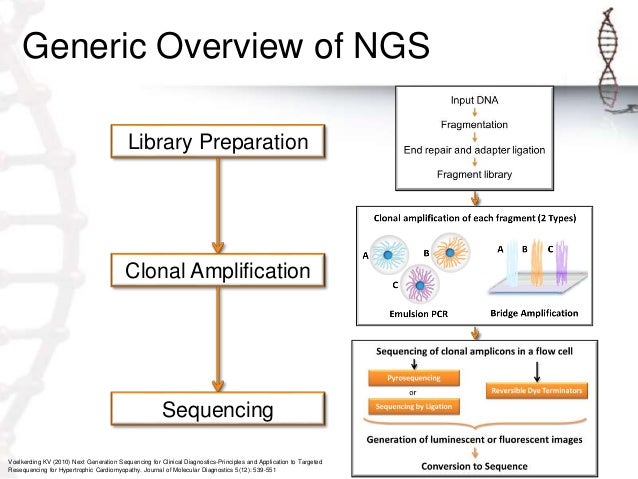
Next-generation sequencing (NGS), also known as high-throughput sequencing, is the catch-all term used to describe a number of different modern sequencing technologies including: Illumina (Solexa) sequencing Roche 454 sequencing Ion torrent: Proton / PGM sequencing SOLiD sequencing These recent technologies allow us to sequence DNA and RNA much more quickly and cheaply than the previously used. In next generation sequencing workflows, nucleic acid is extracted from a sample and fragmented, arranged into platform-specific library constructs, amplified and sequenced. Regardless of the sample type or the platform used, every step throughout this workflow is critical for successful results. Massive parallel sequencing or massively parallel sequencing is any of several high-throughput approaches to DNA sequencing using the concept of massively parallel processing; it is also called next-generation sequencing (NGS) or second-generation sequencing.Some of these technologies emerged in 1994-1998 and have been commercially available since 2005. The presence of certain mutations may inform clinical management. This multigene panel by massively parallel sequencing (next generation sequencing) is a more cost-effective approach when compared to the cost of multiple single gene tests. This test can be used to complement the morphologic and cytogenetic workup of myeloid malignancies.
Next Gen Sequencing Platforms: “Sequencing by synthesis” is perhaps the most well-established sequencing method, and is used by the 454, Illumina, Qiagen, and Ion Torrent (Thermo Fisher) platforms, with each platform utilizing their own proprietary technologies. Next-Gen Sequencing. In 2003, scientists and researchers officially completed the Human Genome Project, a groundbreaking accomplishment to sequence, or map and identify, all of the genes of an entire human genome. The endeavor began in 1990, cost nearly $3 billion, and involved an unprecedented global collaborative effort.. Key Difference – Microarray vs Next Generation Sequencing DNA sequencing processes are used widely in the fields of biotechnology, virology, medical diagnosis and forensic sciences.It is a process which determines the exact order of the nucleotides, adenine, guanine, thymine and cytosine present within a DNA molecule. DNA sequencing procedures have become an accelerant for miraculous. Next Gen Sequencing About VANTAGE NGS Our mission at VANTAGE NGS is dedicated to provide resources and support on finding the right NGS solution for your research.
Next-generation sequencing (NGS) is a high-throughput methodology that enables rapid sequencing of the base pairs in DNA or RNA samples. Supporting a broad range of applications, including gene expression profiling, chromosome counting, detection of epigenetic changes, and molecular analysis, NGS is driving discovery and enabling the future of personalized medicine. Next Generation Sequencing (NGS) has the potential to unlock causative factors from our genetic material. Because of the sheer magnitude, precision and utilizable nature of the output data, a wealth of information will soon be available from studies completed using NGS. Avance Biosciences is offering GMP/GLP next generation DNA Sequencing services using Illumina’s state-of-art MiSeq and. Come, try Elim’s next gen sequencing Services, and experience a completely different spirit of speed, reliability, and service. Whether it is one sample, or a large project, we will work with you to provide the next generation sequencing service that is specific to your needs. Next-generation sequencing (NGS) technologies using DNA, RNA, or methylation sequencing have impacted enormously on the life sciences. NGS is the choice for large-scale genomic and transcriptomic sequencing because of the high-throughput production and outputs of sequencing data in the gigabase range per instrument run and the lower cost compared to the traditional Sanger first-generation.

1) Next Generation Sequencing (NGS) An Introduction
Пин от пользователя Anna Kehrmann на доске Gattaca 2.0

Reaping the Benefits of Nextgeneration Sequencing

Almost all steps of NGS library preparation protocols

NextGeneration Sequencing Pinpoints Multiple Mutations

A Method to Increase Accuracy in Next Generation

Next Generation Sequencing

Nextgeneration sequencing current technologies and

Choosing a nextgeneration sequencing pipeline Analysis

DNA sequencing http//labtechnique.accountant/DNA

Basic workflow for NGS experiments. NGS experiments

Next Generation Sequencing (NGS) Market in 2020 Next

on einfrastructures for nextgeneration

Next Generation Sequencing by Dr Arianna Nicolussi by
